Friday, May 29, 2009

Stretching

Stretching is an activity that many of us do not incorporate into our daily routines, but yet has some very positive benefits for our overall health. The key benefits of stretching include:

  1. Lowers the risk of injury
  2. Lowers muscular tension
  3. Increases joint range of motion
  4. Helps correct muscle imbalances
  5. Improves posture, balance, stability and athletic performance
  6. Promotes circulation

While there are several different stretching techniques, the type with which we are most familiar is called active stretching. This involves elongating a muscle to the point of tension and holding for a set period of time. Stretching can be done at any point during your daily routine, but you should always do some stretching both prior to and after doing any physical exercise. The keys to proper static stretching are:

  1. Only elongate the muscle to the point of mild tension – do not push too far!
  2. You should not feel pain when stretching – if you do, either lessen the tension on the muscle or stop
  3. Never “bounce” or “pulse” when stretching – simply hold the muscle in the elongated position
  4. Hold the stretch for 20-30 seconds
  5. Do 1-2 sets of stretches for each muscle

Monday, May 25, 2009

Truth About Carbs

We have all heard or read about the "evils" of carbs. We are told that carbs are a major cause of obesity and poor health. Fad diets have been created around the concept of "low carb" or "no carb" and so-called experts tell us that following those diets will help us lose weight and become healthier. Is this really true?

Unfortunately, a lot of this information is just hype and not based on scientific fact. Carbohydrates, often shortened to "carbs", are a type of biomolecule (other types that are the major components of food are protein and fats/lipids). The human body creates energy from the food we consume - and the body's preferred source of energy is carbohydrates. Carbs provide nutrition that we cannot obtain from either protein or fats, and certain cells in the body (especially in the central nervous system) rely solely on carbs to function correctly. Eliminating or reducing carbs from the diet will actually have a negative impact on overall heath. Furthermore, a special type of carb is known as dietary fibre - which helps regulate digestion and has health benefits including lowering the risk of heart disease and certain types of cancer. Carbs and dietary fibre also help to maintain the feeling of "fullness" or satiety after we eat, so we are less likely to snack between meals. Those individuals who are looking to increase muscle mass need to be aware that carbs are "protein sparing" - this means that the human body burns carbs for energy needs and utilizes the protein we eat to help build muscle mass and repair tissue. Without a sufficient amount of carbs in our diet, the body will be forced to get its energy from other sources including protein, thus lowering the amount of protein available to build muscle.

You might have also heard about the glycemic index - this measures the impact that a particular food has on blood sugar and insulin release when the food is eaten by itself (on an empty stomach). The greater the impact, the higher the glycemic index - which is considered to be a bad thing, since wide fluctuations in blood sugar and insulin levels can be related to an increase in the body's fat storage. The problem with this is that we rarely eat food items separately, each on an empty stomach - instead our meals combine different types of food at one time. The combination of different foods eaten at the same time alters the glycemic index of the individual foods. Nonetheless, it is better to select carbs that are lower on the glycemic index. High glycemic index carbs (that have a high impact on blood sugar and insulin) include foods such as sugar, honey, potatoes, white rice and white bread. Carbs that have a lower glycemic index include whole wheat bread, brown rice, sweet potatoes, beans, lentils, and most fruits and vegetables. Overall, when selecting carbs to include in your diet, it is better to select lower glycemic index options - for example, choose brown rice instead of white rice, whole wheat/grain bread instead of white bread, whole wheat pasta instead of white/plain pasta, sweet potatoes instead of white potatoes, etc.

So do those "low carb" or "no carb" diets really work? In the short run, cutting out or restricting the carbs in your diet will naturally cause a decrease in your total caloric intake (unless you increase the amount of protein and fat) - so this lowering of calories may cause you to lose weight but it would be better to lower your caloric intake of all biomolecules (carbs, protein and fats) proportionately, not just cutting one type. When carbs are cut or lowered in the diet, this decreases the body's store of glycogen (glycogen is created from carbs and stored in the muscles and liver to provide energy when the body needs it) - and when glycogen levels fall this removes water from the body as well. Thus, the majority of the "weight" loss that people notice when they go on a "low carb" or "no carb" diet is just water loss and not fat loss. As discussed above, over the long run, this kind of diet is not a good idea since it deprives the body of necessary nutrients and energy from carbs, which are vital for proper health and the ability to perform physical activity.

As a general guideline, 50-70% of the calories that we consume on a daily basis should come from carbohydrates. Your trainer can give you general information and guidelines on healthy eating, and for specific diet plans you should consult a registered dietitian/nutritionist.

Thursday, May 21, 2009

Longest Muscle

Here is a trivia question - what is the longest muscle in the human body?

Answer: The sartorius muscle

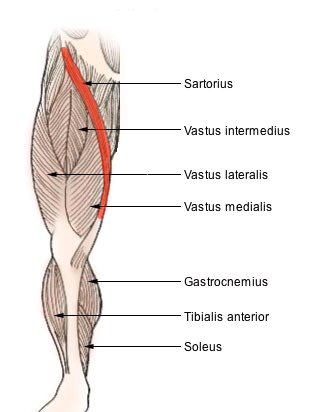
The sartorius is a narrow muscle located in the thigh area of your leg. You have two sartorius muscles - one in each leg. The muscle starts at the top of your thigh near the front outer edge of your pelvis (near what is called the iliac crest - the "bony" part of your pelvis that you can feel at or above your hips). The sartorius then runs along the upper front part of your thigh, towards the inside of your leg where it connects to a tendon just above the side of your knee. Here is an image from Wikipedia highlighting the sartorius.


The sartorius muscle is used for hip flexion (when you bring your knee up towards your chest/abdomen), hip external rotation (when you turn your whole leg so that your foot is pointing away from the centre of your body), hip abduction (when you stand on one leg, keep your other leg straight and move it up and out to your side) and knee flexion (when you bend your leg at the knee so that your heel moves up towards your buttocks).

Monday, May 18, 2009

Fitness Assessment

Before creating or starting any type of workout routine, a fitness assessment should be done. A proper fitness assessment includes both subjective/qualitative information and objective/quantitative information. The subjective information should include items about your history - both medically/physically and generally. Information about your type of job/career, lifestyle, activities, hobbies, and medical condition(s) would be considered subjective information. Objective information, on the other hand, is data that can be measured or calculated. This includes body composition testing, cardiorespiratory assessments, postural assessments and athletic performance assessments. By combining both types of information, a personal trainer gets a comprehensive picture of your past and current situation to assist in developing a training regimen that is best suited to your individual goals, needs and capabilities.

Saturday, May 16, 2009

Training Frequency

A lot of people often wonder how often they should train a muscle group. Many people, even though who have been training for years fall into the belief that more is better. It is not surprising to see people at the gym training chest or arms 3 or 4 times during the week. This is not the best way to achieve your goals and often will just hinder your progress. There is a real risk of over-training if you do not provide your muscles enough time to rest and recover. The actual gains to muscle mass, strength and endurance do not occur during your workout - this happens afterwards during the rest/recovery period. Without providing enough time for this to occur, you put too much stress on your muscles and they will be unable to adapt in the optimal way. As a general rule, you should provide at least 48 hours of rest/recovery (72 hours would be preferable) for a muscle group before training it again. Scientific research has shown that training a muscle group just once or twice a week is sufficient to maintain the benefits that training provides. In determining your workout routine during the week, you should keep this in mind when alternating which muscle groups you will train on each day so that they get enough rest/recovery before training them again.

Wednesday, May 13, 2009

What is Proprioception?

Chances are that you have never heard of the term "proprioception". What is it and why is it important to you?

Proprioception is your ability to sense the position, location, orientation and movement of your body and its parts - such as your arms, legs, hands, feet, etc. This is accomplished through the interconnected nature of your central nervous system (brain, spine and nerves) with sensory receptors located throughout the body (known as "mechanoreceptors") in your muscles, tendons and joints. Proprioception is related to muscle memory and hand-eye coordination.

Just as we can train for improved strength, endurance or power, we can train to improve our proprioception. In fact, enhancing your proprioception can help with your training for those goals of improved strength, endurance or power. How exactly do we train to enhance our proprioception? This involves exercises that challenge us to build our internal balance and stabilization. In order to achieve this, the exercise is done in a "proprioceptively enriched environment" - defined by NASM as an unstable, yet controllable physical situation. What does this mean? I'll give you an example for training your chest (pectoral) muscles - a common exercise that is done for chest is a bench press. For the standard bench press, you lie on a flat, stable bench and use a barbell for weight resistance. To change this to a proprioceptively enriched environment, we could replace the flat bench with a stability ball and replace the barbell with dumbbells. These alterations make the exercise conditions more "unstable" - you will have to utilize your balance and stabilizing muscles throughout the exercise. The exercise is still done in a controllable manner - you would use a lighter weight than what you would use with a standard bench press, so that you can safely perform the exercise.

Overall, training to enhance your proprioception will help you along your path to achieving your fitness goals, whether that includes increased strength, muscle mass, endurance and/or power. Incorporating exercises performed in a proprioceptively enriched environment will also assist with improving your balance and stability.

Saturday, May 9, 2009

Proper Breathing Technique

In this post, I discuss proper breathing technique. First, I briefly talk about what breathing is and why proper breathing is important. I then explain proper breathing technique. Lastly, I cover dysfunctional breathing and the Valsalva maneuver.

What is breathing?
Breathing, in its simplest description, is the process of moving air in and out of the body. This involves various organs/structures, bones and muscles - the lungs, trachea, larynx, nasal/oral cavity, ribs, sternum, diaphragm, intercostals, abdominals and more. All of these parts work together, often without any conscious effort from us - we rarely have to think about breathing, our body simply does it for us.

Why is proper breathing important?
While we don't often give much thought to our breathing, it is vital to our existence - without it, we would perish. Breathing allows us to gather oxygen from our environment, which is transferred into our cardiovascular system (enters into the blood deep within the lungs). In exchange, carbon dioxide and waste gases are taken out of the blood and then exhaled from the lungs. The cardiovascular system (consisting of the heart, veins, arteries, capillaries and blood) then transports the oxygen throughout the body and collects waste. Oxygen is utilized by every type of cell in our body, but is especially important for creating energy - used when we are lifting weights, running or performing any other physical activity. This is why we often find ourselves gasping for air after running or when we have to expend a lot of energy to do an intense physical task - our body is simply trying to obtain more oxygen to replenish its energy levels.

Proper breathing technique
Now that it should be clear that breathing is a very important process, let's look at proper breathing technique. Since we do not often give much thought to breathing, it is important that we consciously maintain proper breathing while we exercise. This will ensure that we are providing enough oxygen to help us with our workout. When we inhale, we should bring air in through the nose and not through the mouth. Breathing through the nose helps to adjust the temperature and moisture level of the air as it begins to enter the lungs, as well as to act as a filter for the air (tiny hairs in the nasal cavity work to prevent particles from entering our lungs). Breathing should be deep, often called "belly" breathing fully using the diaphragm, abdominals and intercostals. When you inhale, your belly should expand with your belly-button or navel moving out from your spine. When you exhale, your belly should contract with your belly-button or navel being drawn in towards your spine. While exercising, you should inhale on the resting or "easy" phase of the exercise and exhale on the exertive or "difficult" phase of the exercise. For example, when doing a push-up, breathe in when you lower your chest to the floor and breathe out when you push your chest away from the floor.

Dysfunctional breathing
If we don't pay sufficient attention to our breathing technique, we can find ourselves suffering from dysfunctional breathing. This is often a breathing pattern with short, shallow breaths. Instead of properly utilizing the diaphragm, abdominals and intercostals, the breathing process is concentrated in the upper chest. There is no expansion/compression of the belly with each breath - instead all of the movement is restricted to the upper chest. This type of breathing does not allow for the proper exchange of oxygen, carbon dioxide and waste gases. With dysfunctional breathing, we do not get enough oxygen and we retain too much waste in the blood and muscular tissue. Dysfunctional breathing can lead to increased tension, headaches, lightheadedness, dizziness, fatigue and feelings of anxiety.

Why the Valsalva maneuver has no place in exercise
The Valsalva maneuver is the attempt to exhale forcibly against a closed airway. Often, the Valsalva maneuver is used (consciously or not) when we have to exert a lot of energy - you might have seen people doing this at the gym when trying to lift a very heavy weight, usually during exercises such as bench press or squats. They inhale just before lifting the weight, and then just as they begin to lift they close their mouth/airway and stop breathing, often with their face turning red. After completing the exercise they then exhale. This breathing process should never be used while exercising. Essentially, the Valsalva maneuver creates a large increase in the pressure within the chest cavity. Aside from the fact that breathing is stopped with the Valsalva maneuver (thus preventing the necessary intake of oxygen and the expulsion of carbon dioxide and waste gases), there are some potentially severe side effects of the maneuver. At the start of the Valsalva maneuver, there is an initial spike in the individual's blood pressure (dangerous for those who have heart disease, high blood pressure or who could be susceptible to an aneurysm or stroke). Then there is a sudden drop in blood pressure, since the increase of pressure within the chest cavity prevents blood from flowing into the chest and to the heart. This drop in blood pressure is combined with a rapid increase in the pulse, since the body is trying to compensate for the low blood flow into the heart and lungs. Then when the individual finally exhales and the chest cavity pressure is released, the pulse drops and the blood pressure shoots back up - often spiking higher than the blood pressure before the Valsalva maneuver began. Throughout the maneuver, the reduced flow of oxygenated blood flow to the muscles and brain can cause dizziness and even fainting. If you find yourself holding your breath during exercise, take a quick break to focus on re-establishing proper breathing technique. Again, never use the Valsalva maneuver while exercising.

Wednesday, May 6, 2009

The OPT Model - Power Level

In my final posting about the OPT model, I will discuss the third level - Power. This level consists of one phase called power training. Individuals who have successfully completed training programs at the previous four phases (in the Stabilization and Strength levels) can progress to power training. This phase of training emphasizes the development of speed and power. Not every individual will decide to progress to this level, but it is a good application for those who are athletes or who want to improve their performance in a variety of sports. Exercise combinations in the strength level of training often incorporate supersets of a traditional strength exercise followed by a power exercise.

Monday, May 4, 2009

The OPT Model - Strength Level

The second level of the Optimum Performance Training model is Strength. This level consists of three phases: strength endurance, hypertrophy and maximal strength. Once you have successfully completed the stabilization level of the OPT model, you can progress towards building strength by increasing the amount of weight resistance for a moderate number of repetitions (still maintaining proper technique and posture). Hypertrophy refers to the process of increasing muscle mass/size, while maximal strength focuses on lifting heavier weights for a low number of repetitions. Supersets (two or more exercises performed back-to-back with minimal rest) are often incorporated into this level. Many individuals will decide to progress only towards this level of the OPT model, while others will continue on to the third level.

Sunday, May 3, 2009

The OPT Model - Stabilization Level

The first level of the Optimum Performance Training model is Stabilization. This level consists of one phase: stabilization endurance. This phase of your training seeks to increase muscular endurance and stability. A key feature is to promote neuromuscular efficiency - in plain words, this is how your nervous system (your brain, spinal cord and nerves) communicate with your muscular system. Exercises and training components focus on balance, posture, flexibility and stability. Often, exercises in this phase are done with lower weight and higher repetitions. It is vital that you work on your stabilization training before performing more advanced training for strength and power, especially for injury prevention. Also, improved neuromuscular efficiency will enhance the benefits from strength and power training in the subsequent OPT model levels.

Saturday, May 2, 2009

The OPT Model

The Optimum Performance Training (OPT) model was created by the National Academy of Sports Medicine (NASM) and is based on current scientific and medical research. It is a concept that incorporates multiple types of training in an integrated, progressive system. The OPT model consists of three levels: Stabilization, Strength and Power. The next few blog entries will go into the OPT model in some detail, so this will illustrate how a personal training program developed under this system will help you reach your fitness and athletic conditioning goals in a safe and effective manner.

Friday, May 1, 2009

PFPT Website

The official website for Pinnacle Fitness Personal Training has been launched! Please visit http://www.pfpt.ca/. My blog will be used to provide regular tips and information about personal training and fitness.